Receptor pharmacology
Sermorelin mechanism of action
A short fragment prompts a pituitary response. The useful complication is that the signal's duration, the hormone's duration and the body's feedback each have their own story.
GHRH receptor signaling
Sermorelin binds GHRH receptors on somatotrophs, the growth-hormone-producing cells in the anterior pituitary. Receptor activation starts adenylate cyclase / cAMP / protein kinase A signaling inside the cell, stimulating growth-hormone synthesis and release. The GHRH pharmacology review describes the pathway and the shorter active fragment that sermorelin copies.
The cascade of initials initially distracted me from the source of the hormone: the pituitary supplies it. Sermorelin provides a releasing signal, and the gland's ability to respond matters. That explains why GHRH also had a diagnostic role in assessing pituitary growth-hormone reserve. A response to a stimulation test and an improvement during treatment answer different questions.
The GH / IGF-1 axis
Growth hormone stimulates the liver's production of IGF-1. Feedback through IGF-1 and somatostatin, the opposing inhibitory signal, remains operative during GHRH stimulation. This feedback-regulated, pulsatile pattern is the biological attraction of acting upstream.
Walker made the case for that approach in a Sermorelin editorial. I appreciate its physiological argument, but an editorial can only argue the case; comparative clinical outcomes require a trial. Direct recombinant growth hormone supplies the hormone itself and bypasses the releasing step. The distinction explains the mechanisms without settling which treatment would fit any individual.
Sermorelin half-life
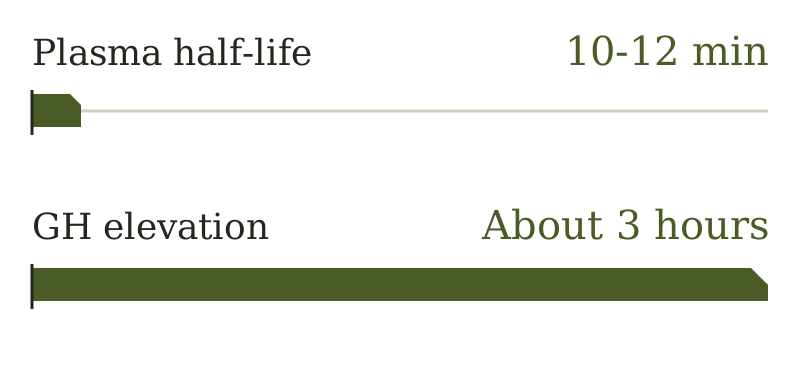
The intravenous plasma half-life was about 10-12 minutes. A half-life describes the time for the plasma concentration to fall by half, so it does not mark complete disappearance. In Wilton's study of 30 healthy men, growth hormone remained elevated for about 3 hours despite rapid peptide elimination.
These separate clocks are easy to collapse into one claim about how long sermorelin works. I enjoy the mismatch precisely because it forces a more exact question: are we timing the peptide in plasma, the hormone response, or an outcome such as growth? The study-dose archive adds the routes and populations that gave those times their context.
Continuous infusion
In six children with partial growth-hormone deficiency, continuous subcutaneous GHRH(1-29)-NH2 infusion initially raised integrated growth hormone. The response then declined by 3 to 6 months; one child had complete suppression of secretion. The investigators considered antibodies, changes in somatostatin and receptor desensitization as possible explanations.
That small experiment punctures my instinct to equate a longer signal with a stronger result. It establishes what happened under continuous infusion in those children. The unresolved mechanism is part of why translating it into a personal dosing rule would be a mistake.
Sermorelin vs CJC-1295 and Ipamorelin
CJC-1295 shares the GHRH-receptor route and was engineered for longer action. Amino-acid substitution slows breakdown, while the DAC form uses an albumin-binding group to extend exposure. The GHRH-analog review provides the wider pharmacological context.
Ipamorelin acts through the ghrelin / growth-hormone-secretagogue receptor. It can also stimulate growth-hormone release, but starts at a different receptor. A question about capromorelin MOA needs capromorelin evidence. The studies cited here do not provide that comparison.
For tesamorelin, the dedicated comparison follows the actual study populations. Receptor kinship is useful for organizing the cabinet; each molecule still needs its own outcome evidence.